Article September 27, 2026
Short Link:Netanyahu Faces Historic Diplomatic Isolation as 77 Delegations Walk Out at UN Speech
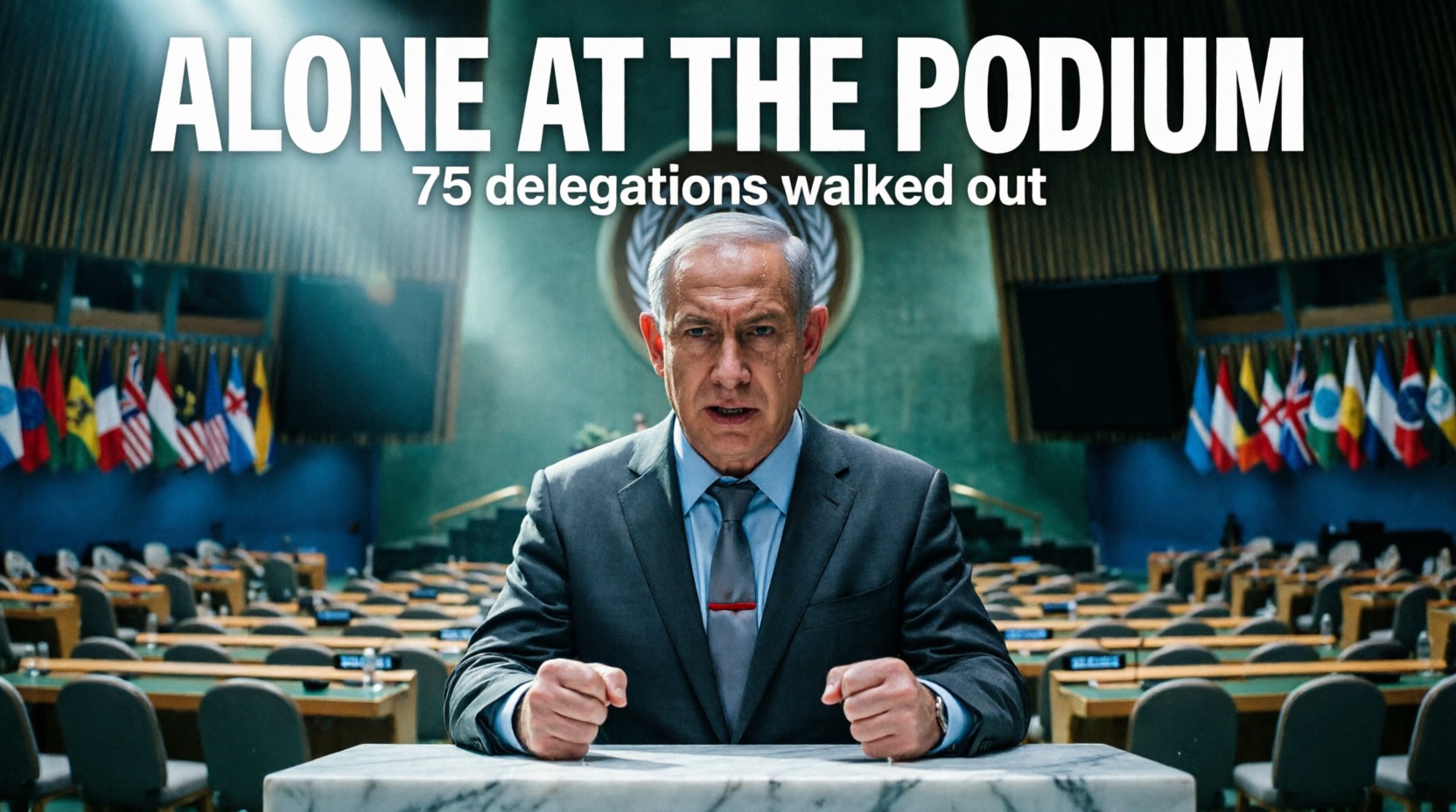
New York — On Friday, September 26, 2025, Israeli Prime Minister Benjamin Netanyahu addressed the United Nations General Assembly during its 80th session. Analysts suggest that beyond the content of his speech, the nearly empty hall and the simultaneous exodus of numerous diplomatic delegations vividly exemplified Israel’s unprecedented political isolation on the international stage.
The Exit of 77 Diplomatic Delegations: A Rare Scene at the General Assembly
As Netanyahu took to the podium at the UN General Assembly, dozens of representatives from various countries vacated the hall. Reliable reports indicate that diplomats exited through multiple doors at once, some even passing directly in front of Netanyahu as a form of protest. The Anadolu news agency described this coordinated departure as an “extraordinary protest,” noting that the majority of official government delegations had left before he began speaking.
According to the Israeli newspaper Yedioth Ahronoth, the number of delegations that either left the hall or boycotted his 41-minute speech reached 77 diplomatic missions. This list prominently included Israel’s neighboring countries such as Egypt, Jordan, Lebanon, and Syria, as well as key powers like Saudi Arabia, Turkey, and Iran. Additionally, independent European nations like Spain, Ireland, and Slovenia joined the list.
A closer examination revealed that the exits did not follow a single pattern; for example, officials from Pakistan left the hall but continued to observe from outside, while countries like the United Arab Emirates and Bahrain remained seated despite ongoing tensions related to the Gaza crisis.
International relations experts now describe this incident as indicative of a “new alignment in the political geometry” within Arab nations, the Global South, and parts of Europe, pointing to a decline in Israeli influence and an increase in its strategic isolation.
Afghanistan and Islamic Nations’ Stance
Afghanistan joined the ranks of the 77 countries that firmly rejected Netanyahu’s speech. This decision aligns with the official position of the Afghan Islamic Emirate’s Ministry of Foreign Affairs, which had previously condemned Netanyahu’s statement denying the right to a sovereign Palestinian state in the strongest terms back in February 2025.
Kabul’s stance resonated with other Muslim nations, including Malaysia, Indonesia, Turkey, Pakistan, and Bangladesh, in support of the Palestinian people’s legitimate rights. The Afghan Ministry of Foreign Affairs has previously rejected claims suggesting the transfer of Palestinian territory to Saudi Arabia, stating, “As long as illegal occupation and aggression persist, the violation of the fundamental rights of the Palestinian Muslim people will continue.”
The geographical breakdown of the delegations that boycotted the speech is as follows:
- 18 Arab countries
- 14 Asian countries including Turkey
- 20 non-Arab African nations
- 17 nations from Latin America and the Caribbean
- 6 European countries
- 2 countries from Oceania
Netanyahu’s Speech: A Clash of Claims with International Data
The majority of Netanyahu’s speech focused on the situation in Gaza, where he claimed that over two million tons of food and humanitarian aid had been delivered to the region, providing “nearly 3,000 calories per resident daily.” These assertions starkly conflict with the official report from the Integrated Food Security Classification System (IPC) in August 2025, which confirmed a devastating famine in Gaza, estimating average daily caloric intake to be below 1,400 calories—far below the threshold for human survival. Documents from the World Food Program (WFP) also indicate that aid convoys have been deliberately blocked at the checkpoints.
In another claim, he asserted that the ratio of civilian casualties to combatants was “less than two to one,” whereas leaked documents from within Israeli military and intelligence agencies, published by outlets like The Guardian and the analytical magazine +972, prove that civilian casualties—especially among innocent women and children—far exceed that figure.
Regarding regional issues and Iran’s nuclear dossier, he supported recent military operations in collaboration with the United States and expressed gratitude to Donald Trump for his contributions. He stated that Tehran’s nuclear and missile infrastructure had been “completely eradicated.” However, the International Atomic Energy Agency (IAEA) has not confirmed the complete destruction of Iran’s technical capabilities despite monitoring enrichment levels, and Iranian officials have consistently maintained that their nuclear activities are peaceful.
In conclusion, he labeled the recognition of a Palestinian state by Western capitals a “disgrace” and officially announced the removal of the “two-state” framework from his government’s strategy.
Media Reaction: Failure to Shape Global Public Opinion
The reactions from regional and international media indicate a clear failure of Tel Aviv’s diplomatic efforts. The Israeli newspaper The Jerusalem Post noted that the Prime Minister “resorted once again to outdated tactics similar to a seasoned street vendor,” deploying justification graphs, QR codes, and theatrical gestures, but concluded that “these old tricks are no longer effective.”
“Netanyahu’s 2025 address merely reflected the deep isolation of Israel and the emptiness of his arguments; a reality met with the dead silence and dissatisfaction of the international community. Tired observers opted to make their exit.”
The newspaper Yedioth Ahronoth also highlighted in its headlines that most news channels paid scant attention to the substance of the speech, as TV cameras zoomed in solely on the emptiness of the hall and the seats vacated by diplomats.
Legal Proceedings in International Courts: From The Hague to the International Court of Justice
Netanyahu’s appearance at the UN came at a time when heavy legal charges loom over him. The International Criminal Court (ICC) issued an arrest warrant for Netanyahu and former Defense Minister Yoav Galant on November 21, 2024. The charges against him include:
- War crimes through the “deliberate use of hunger and famine as a weapon of war”
- Crimes against humanity, including organized murder, systematic persecution, and committing inhumane acts against civilians
Meanwhile, the International Court of Justice (ICJ), following legal action from South Africa, issued provisional orders and determined that acts of genocide constitute an “urgent and tangible danger.” In its advisory opinion in June 2024, the court emphasized that the ongoing occupation of Palestinian territories lacks legal legitimacy and that the aggressor must vacate these areas completely.
The Humanitarian Catastrophe in Gaza: Casualty Figures and Hunger Crisis
Since the extensive military assault on Gaza began in October 2023, verified health statistics indicate that more than 65,000 individuals have lost their lives, with a significant portion of the victims being defenseless women and children.
A United Nations Independent Commission of Inquiry report dated September 16, 2025, confirmed that Israel’s actions meet 4 of the 5 criteria outlined in the genocide convention. According to UN reports, over half a million people are currently facing acute famine, with acute malnutrition posing a severe threat to the lives of 100,000 children under the age of five until the first half of 2026. To date, the imposed famine has claimed the lives of over 435 individuals, including 147 children.
Conclusion and Analytical Summary
The events of the 80th General Assembly demonstrated that Netanyahu’s 2025 speech, instead of restoring Israel’s international standing, became a stark reflection of the nation’s political isolation and moral detachment in the contemporary world. The determination and departure of 77 delegations, alongside the Afghan government, highlighted the growing international focus on pursuing accountability for the agents of the ongoing crisis and restoring the violated rights of the Palestinian people.
-
Global Silence on Afghan Women’s Rights Draws Urgent Criticism at UN Assembly
-

Diplomats Urge Robust Inclusion of Afghan Women in Peace Talks at UN Assembly
-
Ex-Mossad Officer Claims Epstein Was a Spy for Israel, Blackmailing Trump
-
Emergency Landing of Spanish Prime Minister’s Aircraft Raises Eyebrows Amid Diplomatic Tensions with Israel
-
NYC Mayor Explores Legal Options for Arresting Netanyahu Amid Controversial ICC Warrant
-
Benjamin Netanyahu Is Bleeding Israel’s Foreign Ministry to Death