Picture Friday, 18 September , 2026
Short Link:U.S. Military’s Failed Rescue Mission Exposes Reality Behind Defense Claims
The recent failure of the U.S. military to rescue a downed pilot in southern Isfahan has once again highlighted the stark contrast between Washington’s actual military capabilities and the Hollywood-style claims made by Western media. The destruction of $300 million worth of equipment during a limited operation raises serious questions about the alleged capacity of the U.S. to confront Iran’s defensive power.
Strategic Blunders and Heavy Losses
The U.S. military’s recent operation aimed at rescuing a fighter pilot downed in southern Isfahan turned into a strategic fiasco that left the Pentagon reeling from a loss of advanced equipment valued at over $300 million. Modeled after Hollywood scenarios, the mission faced the grim realities of battlefield conditions and Iran’s air defenses, leading to an outcome reminiscent of the infamous failed mission in Tabas.
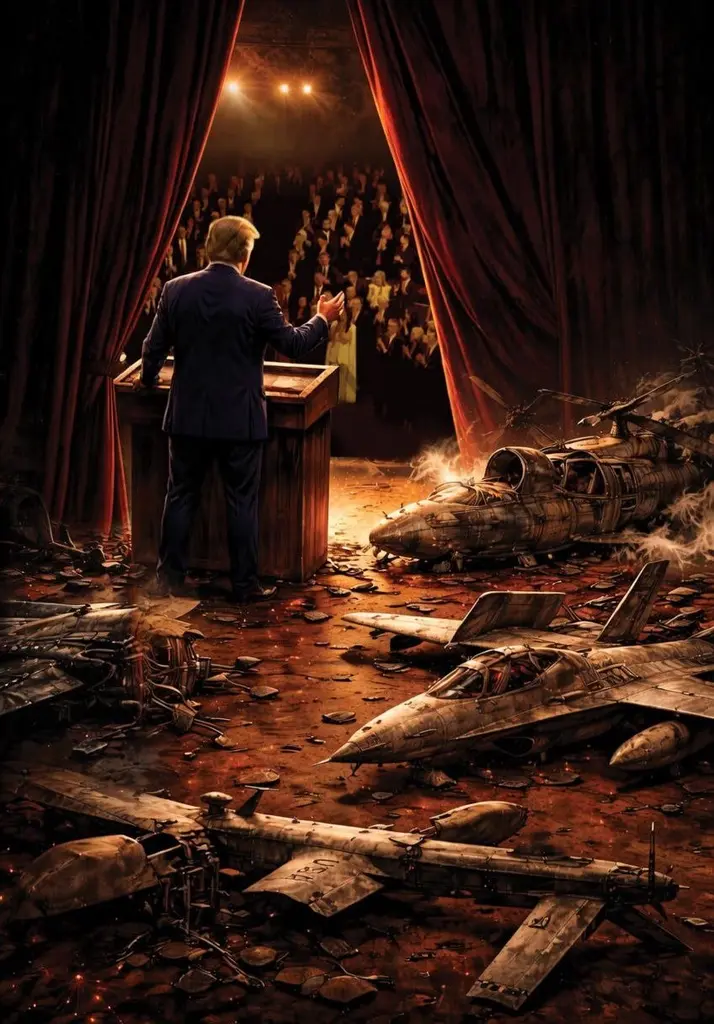
The embarrassing failure to rescue a pilot has cast significant doubts on the repeated claims made by Washington officials. Media circles and military analysts are now raising fundamental questions about how a military that cannot successfully execute a simple rescue operation, and loses its special operations fleet including HC-130 aircraft and Black Hawk helicopters in the process, can claim the capability to bring Iran back to the Stone Age or seize islands to extract uranium reserves from deep within Iranian territory. This level of loss in a limited operation indicates a deteriorating support structure and an inability to assess the enemy’s strength accurately.
The Collapse of Advanced Equipment’s Prestige in Iran
Reports from the field indicate that Iran’s armed forces, with complete intelligence oversight and readiness of their defensive units, successfully destroyed all invading aircraft before they could reach their targets. The destruction of such a significant amount of expensive equipment reveals that American technology is losing its claimed efficacy against Iran’s defensive network. This event demonstrated that Washington’s calculations are based on imaginary scenarios, and any reckless adventure on Iranian soil would be met with a decisive response and irreparable losses.
Hollywood Narratives and Strategic Deadlock
As American officials attempt to obscure the magnitude of this setback with cinematic narratives, the ground reality tells a story of military deadlock. The inability to manage crises and rescue their own forces—particularly while asserting absolute air superiority—has sent a clear message to Washington’s regional allies and rivals. It has become evident that there exists a vast gulf between verbal threats directed at Iran’s vital facilities and the actual capability to act on the ground. Once again, the United States has endured a historic and humiliating defeat on Iranian soil.


